A dining room that’s full while the delivery queue stays quiet, or the other way round, usually isn’t luck — it’s what happens when an F&B brand markets itself the way a generic retailer would. Food and beverage buying decisions in Malaysia are fast, visual, hyperlocal and heavily repeat-driven, in ways that most standard digital marketing advice simply doesn’t account for. An outlet that treats its Instagram feed, Google Business Profile, delivery app listing and WhatsApp broadcasts as separate, disconnected jobs is leaving footfall, orders and repeat customers on the table.
How F&B Customers Actually Decide Where to Eat
Most purchase decisions in F&B are made in minutes, not days, and they’re made on impulse cues rather than a considered comparison process. Someone scrolling TikTok at 6pm, hungry and fifteen minutes from home, isn’t building a shortlist — they’re reacting to whatever looks good and feels close by. That compressed decision window changes what actually earns a customer, and it’s a large part of why marketing built for considered-purchase categories underperforms so badly when applied to food.
Discovery happens on video, not on your website
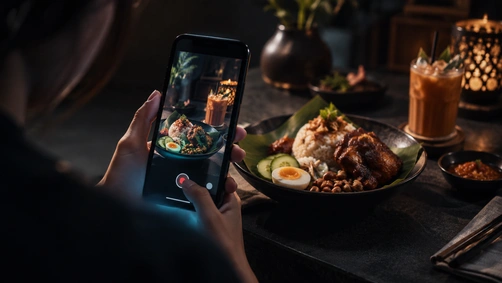
Instagram Reels and TikTok have become the default discovery layer for Malaysian F&B — not the brand website, and often not even Google. A well-shot fifteen-second clip of food being plated or a drink being poured does more to generate a first visit than a menu page ever will, because it answers the only question that matters at that stage: does this look good enough to try. Outlets that under-invest here are effectively invisible to the audience segment doing the most browsing.
Evaluation happens on Maps and reviews, in seconds
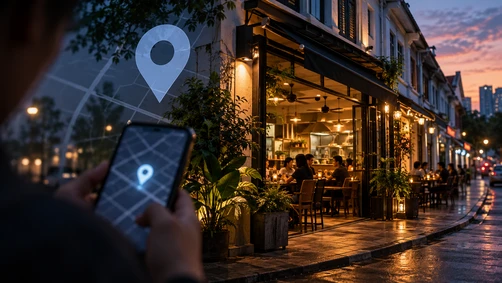
Once something looks appealing, the next step is almost always a glance at Google Maps or the ratings on a delivery app — star rating, recent reviews, photos, whether it’s currently open. This evaluation step takes seconds, not minutes, which means a thin or outdated Google Business Profile can undo the work a good piece of content just did. A restaurant with excellent food and a neglected profile regularly loses customers to a mediocre competitor with a well-maintained one.
The purchase itself splits into at least three different funnels
Dine-in, takeaway or pre-order, and delivery-platform ordering aren’t the same transaction wearing different clothes — they carry different margins, different lead times and different customer expectations. A campaign optimised purely for delivery orders can quietly cannibalise higher-margin dine-in visits, and a promotion built for foot traffic won’t move the needle on platform orders at all. Treating “more orders” as a single goal, rather than three related but distinct funnels, is one of the more common planning mistakes in this sector.
Where F&B Marketing in Malaysia Usually Goes Wrong
The most common structural problem is over-reliance on delivery platforms as the primary acquisition and retention channel. Platforms like GrabFood and Foodpanda are genuinely useful for reach and convenience, but every order placed through them comes with a commission and very little usable customer data — no email, often no phone number, and no easy way to bring that customer back through owned channels. A brand that never builds a direct relationship with its customers is permanently renting its own customer base.
The second is chasing follower count and engagement metrics that don’t translate into repeat visits. A viral video can fill a dining room for a weekend and say almost nothing about whether those same customers come back a month later. Vanity metrics feel like progress because they’re easy to see, but they’re a poor proxy for the number that actually matters to the business: how many customers return, and how often.
The third is running one-off promotions with no retention mechanism attached. A 20% discount brings in a burst of first-time or lapsed customers, but without a way to capture their details and follow up — a WhatsApp opt-in, a loyalty stamp, a membership sign-up — that spike disappears as quickly as it arrived. The promotion did its job of generating a visit; it just didn’t do the second, more valuable job of turning that visit into a relationship.
The fourth, common among multi-outlet brands, is managing marketing at the brand level only and neglecting the outlet level. A single Google Business Profile shared across locations, or generic ads that don’t localise to the outlet nearest the customer, ignores the fact that F&B is fundamentally a local, proximity-driven purchase. Each outlet needs its own visibility, its own reviews and its own local targeting, even under one brand umbrella.
Channels Worth Prioritising
Local SEO and Google Business Profile management matter more here than almost any other sector MRVS works with, because so much of the evaluation step happens directly on Maps. Keeping each outlet’s profile current — accurate hours, fresh photos, prompt replies to reviews — is often a higher-leverage activity than any single ad campaign, and it’s frequently the most under-resourced part of an F&B brand’s marketing.
Short-form video and creator seeding, particularly with micro and nano influencers rather than only large-following names, tends to produce more credible, higher-converting content than brand-produced ads. Malaysian audiences are practised at spotting an obvious paid endorsement, and a genuine-feeling recommendation from a smaller, locally relevant creator often outperforms a polished campaign from a bigger one.
Paid social earns its keep around specific moments — a new outlet opening, a new menu launch, festive periods like Raya, Chinese New Year or Merdeka — where geo-targeted radius campaigns around each outlet can drive a genuine spike in trial. It’s a weaker fit as an always-on channel for routine footfall, where organic content and local search visibility usually carry more of the load.
Paid search plays a narrower but still useful role — catering enquiries, franchise or corporate bulk orders, and event bookings are genuine search-driven decisions where targeted advertising can capture high-value demand that social content won’t reach.
Owned channels are the piece most F&B brands underinvest in. A website or ordering system that lets customers order directly, paired with WhatsApp broadcasts for loyalty offers, new launches and reservation reminders, reduces dependency on platform commissions and gives the brand a direct line to its own customers rather than a rented one. MRVS’s customer engagement work with F&B clients typically starts here, because it’s the fastest way to convert one-off visitors into a base the brand actually owns.
Measuring What Actually Matters
Follower count and reach are diagnostic at best. The measures that actually reflect business health are repeat-visit rate, average spend per visit, and — critically for this sector — the proportion of revenue coming through owned channels versus delivery platforms. A brand growing overall revenue while that platform-dependency ratio keeps climbing is often building a business it doesn’t fully control.
Attribution needs deliberate work here too, since so much of the customer journey happens off-website. Unique promo codes, table-side QR codes and platform-specific tracking links are simple, low-cost ways to work out which channel actually drove a visit or an order, rather than guessing based on which channel got the most impressions. Without that, it’s easy to keep funding whichever channel feels most active rather than the one that’s actually converting.
Bringing the Pieces Together
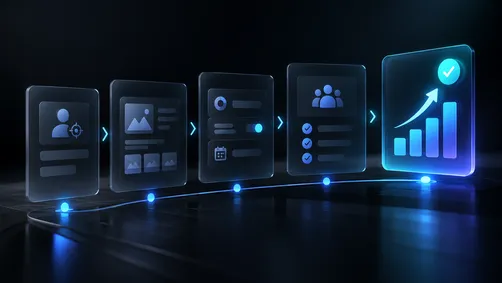
The F&B brands that get the most out of their marketing in Malaysia are the ones that stop treating content, local search, paid media, the website and customer messaging as separate projects. A great Reel that lands a first visit is only worth as much as the loyalty mechanism waiting to bring that customer back; a strong Google Business Profile is only as useful as the outlet-level targeting behind it. MRVS approaches F&B marketing the way it approaches most sectors with a genuinely local, repeat-purchase customer base: starting with the actual customer journey — discovery, evaluation, purchase, return visit — and connecting the digital marketing channels needed to support each stage, rather than scoping search, social and advertising as unrelated jobs.
If your outlets are getting attention but not enough of it is turning into return customers, that’s usually a journey and retention problem before it’s a content problem. A closer look at where the current approach is losing customers — before spending more on social content or advertising to fill the gap — is often the more useful place to start.