
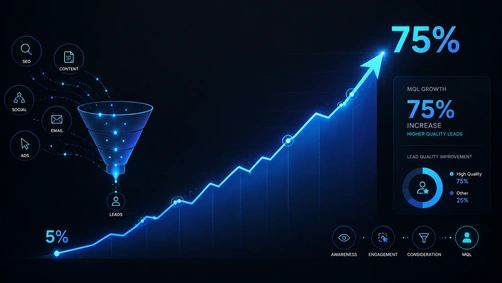
When MRVS began working with Beyonary Group, a Malaysia-based technology and software development company on its Google Search campaigns, the objective wasn’t simply to generate more enquiries. Beyonary needed more qualified business opportunities, and clearer visibility into which campaigns were actually producing them. A significant part of that enquiry journey happened through WhatsApp and the website contact form, and once a prospect moved into either channel, the connection back to the original advertising source became much harder to see.
Our work focused on two things in parallel: improving the SEM campaigns themselves, and building a custom attribution workaround for a conversion journey that standard website and Google Ads tracking could not follow end to end. The objective was to reconnect paid-search attribution with enquiries happening through both the website and WhatsApp, then carry that visibility through to eventual lead-qualification and MQL status.
The Challenge
Beyonary was already running Google Search campaigns that generated a steady flow of enquiries, split fairly evenly between website contact forms and WhatsApp. The issue wasn’t how many people were getting in touch. It was that enquiry volume and cost per lead told us very little about which of those enquiries were actually worth pursuing.
A low cost per lead means very little if the leads aren’t qualified. Without a way to trace enquiries through to a genuine business outcome, campaign decisions were being made on the strength of a metric that couldn’t tell the difference between a strong prospect and a dead end.
What We Found
When we reviewed Beyonary’s SEM and enquiry journey, the gap wasn’t lead volume. It was measurement.
Standard website conversion tracking could tell us when certain on-site actions occurred, such as a successfully tracked contact-form submission. We could also configure tracking around the point where a visitor clicked from Beyonary’s website into WhatsApp.
But that was where the visibility ended. Once the prospect entered WhatsApp, neither Google Ads nor the website could natively see what happened inside that conversation — whether the person actually made an enquiry, whether the enquiry was relevant, or whether Beyonary eventually classified the prospect as an MQL.
This meant two WhatsApp clicks could look identical from an advertising perspective even though their business outcomes were completely different. One could disappear after opening WhatsApp; another could become a high-quality sales opportunity. Standard conversion reporting had no native way to distinguish between them. That was the gap we set out to solve.
The WhatsApp Attribution Gap
A meaningful share of Beyonary’s prospects were reaching out on WhatsApp rather than filling in a form, which is typical for many Malaysian businesses. The path usually looked the same: someone searches on Google, clicks an advertisement, browses the website, then starts a WhatsApp conversation instead of submitting a form.
That’s where standard tracking tends to stop. We can configure website analytics and advertising tracking to record the point at which a visitor clicks through to WhatsApp. But that click is only the hand-off between the website and an external conversation. Standard tracking does not follow the prospect into WhatsApp or automatically return the eventual outcome of that conversation to the original Google Ads campaign.
For Beyonary, that created a broken attribution chain: we could see where the prospect came from, and the sales team could later see whether the prospect was qualified, but those two pieces of information were not naturally connected.
What We Did: Connecting Enquiries Back to Their Campaigns
Because there was no native end-to-end tracking path between Google Ads, Beyonary’s website, WhatsApp conversations and eventual lead qualification, we built our own attribution layer to bridge those points.
The workaround was designed to preserve the paid-search context before a prospect left the trackable website environment, associate that information with the resulting enquiry, and reconnect the lead’s eventual qualification outcome with the advertising activity that originally generated it.
In practical terms, we were reconstructing a conversion journey that would otherwise have been fragmented across separate systems:
Google Ads → Website → Contact Form / WhatsApp → Enquiry → Lead Qualification → MQL
We Unified Website and WhatsApp Enquiries
Website contact forms and WhatsApp presented two different attribution problems. Form submissions happened within the website environment, where source and conversion information could be captured more directly. WhatsApp was different: the conversation moved into an external platform where the original campaign context and subsequent lead outcome were no longer naturally connected.
We designed the workflow so enquiries from both routes could ultimately be evaluated within the same lead-quality framework rather than treating website conversions and WhatsApp conversations as unrelated datasets.
This allowed leads generated through WhatsApp or the website contact form to be associated with the paid-search attribution captured earlier in the journey, giving us visibility into the campaign — and where identifiable, the keyword or other campaign-level context — that originally brought the prospect into the funnel.
How We Used the Data to Improve SEM Optimisation
This created a new optimisation layer that wasn’t available from Google Ads’ surface-level conversion reporting alone. We could compare the volume of tracked enquiries against the volume of actual MQLs produced by different parts of the account, exposing campaigns that looked efficient at CPL level but consistently generated poor-quality prospects.
We then used that qualified-lead data to guide campaign optimisation and budget allocation, shifting attention away from campaigns that merely generated inexpensive enquiries and towards those producing a stronger proportion of genuine business opportunities.
The Results: More MQLs, Not Just More Enquiries
The proportion of SEM-generated enquiries qualifying as Marketing Qualified Leads increased from approximately 5% to 75%.
By combining SEM optimisation with the custom attribution workaround, we were able to move Beyonary’s campaign measurement further down the funnel — from initial enquiry actions towards actual Marketing Qualified Leads.
Instead of relying primarily on enquiry volume and CPL, we now had visibility into which advertising activity was producing prospects that actually met Beyonary’s qualification criteria.
Why This Matters Beyond Beyonary
Beyonary’s challenge is common because standard advertising and website analytics were not designed to follow a lead seamlessly through an external WhatsApp conversation and then reconnect the eventual sales qualification outcome with the original ad click.
As a result, many conventional SEM setups — including agency-managed campaigns — stop at the easiest measurable point: the form submission or WhatsApp-button click. Closing the loop beyond that point typically requires additional attribution infrastructure built around the business’s actual enquiry and qualification process.
Takeaway
For Beyonary, moving from roughly 5% to 75% of SEM-generated enquiries qualifying as MQLs required more than campaign optimisation. It required building the missing connection between paid search, website behaviour, WhatsApp enquiries and downstream lead qualification.
That is how MRVS approaches performance marketing: not simply managing what happens inside the advertising account, but building the measurement and attribution infrastructure needed to understand what happens after the click — and using those business outcomes to make better campaign decisions.
MRVS’s Google Ads and SEM services combine campaign management with the tracking, attribution and WhatsApp-based customer engagement work needed to see which activity actually produces qualified leads, not just conversions. Businesses reviewing their own paid search performance may also find it useful to read why Google Ads leads don’t convert even when cost per lead looks fine.