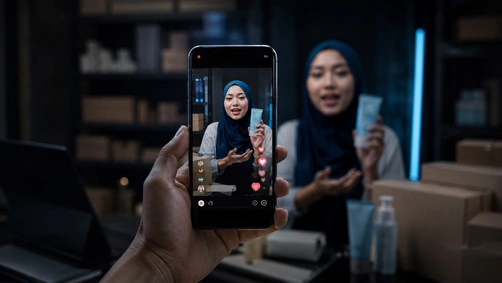
TikTok Shop has just raised its 2026 investment in Malaysian sellers to RM250 million, adding RM70 million to a commission-relief programme it runs jointly with the Ministry of Domestic Trade and Cost of Living (KPDN). Alongside that announcement, TikTok published platform data pointing to a more structural shift: LIVE shopping, once treated as a novelty format bolted onto short video, now accounts for roughly a third of all TikTok Shop sales in Malaysia. Read together, the two signals say the same thing — TikTok Shop is positioning itself as core retail infrastructure for Malaysian sellers, not a side channel for impulse buys.
What TikTok and KPDN Actually Announced
On 20 August 2026, TikTok Shop announced JomLokal Booster 2.0, an extension of the cost-of-living relief programme it launched with KPDN in June. The new package includes:
- An additional RM70 million in seller and shipping support, bringing TikTok Shop’s total committed investment for 2026 to RM250 million.
- 0% platform commission extended to 44 further product subcategories, on top of the 56 subcategories — largely dairy and daily essentials — that already carried zero commission from the June programme.
- An RM2 rebate per order on standard shipping, applied nationwide across eligible listings.
- A new “JomLokal Club” offering matchmaking, training and competitions for local sellers and creators.
TikTok says the JomLokal programme now supports around 400,000 local sellers and creators and roughly 800,000 listed products, with sales through the initiative up 140% year-on-year comparing June 2026 to June 2025.
The Data Behind the Headline Number
The commission relief is the part that made headlines, but the platform data released alongside it is arguably more useful for anyone deciding where to put marketing effort next. TikTok reports that 60% of its users now say they prefer LIVE as a shopping format over static listings or short video, that LIVE sales grew 48% year-on-year, and that LIVE now contributes approximately 33% of total TikTok Shop sales in Malaysia — up from a much smaller share even a year ago.
A few other figures worth noting from the same release:
- Fastest-growing categories year-on-year: automotive (+70%), household appliances (+58%), pet supplies (+57%), home improvement (+47%) and baby & maternity (+45%).
- 97% of surveyed businesses selling on TikTok Shop describe it as an important revenue source, and around half say it now contributes more than 40% of their overall revenue.
- Sales rose 51% during the Ramadan and Raya period compared with a regular trading day — a reminder that some of this growth is seasonal rather than a flat baseline shift.
None of these figures are independently audited third-party statistics — they come from TikTok’s own newsroom release — so they should be read as the platform’s account of its own performance rather than neutral market research. That doesn’t make them useless; a platform doesn’t usually publicise a shift toward a format it isn’t actively pushing sellers to adopt.
What’s Confirmed, What’s Inferred, and What’s Still Unclear
Confirmed: the RM250 million total investment figure, the expansion to 44 additional zero- or reduced-commission subcategories, the RM2 shipping rebate, and the LIVE commerce statistics above all come directly from TikTok’s official announcement with KPDN, dated 20 August 2026.
Reasonably inferred: TikTok is treating Malaysia as a priority market for social commerce in Southeast Asia and is likely to keep layering incentive programmes on top of organic growth rather than relying on either alone. The pairing with a government ministry also suggests TikTok wants Shop associated with cost-of-living relief and legitimate local commerce, not just entertainment-driven impulse spending — a positioning shift that matters for how cautiously B2B or considered-purchase brands might treat the channel.
Not yet confirmed: TikTok has not published an end date for the commission relief or shipping rebate, so it’s unclear whether this is a time-boxed promotion or an ongoing policy. It’s also unclear how much of the LIVE growth is a durable shift in shopping behaviour versus a seasonal spike inflated by the Ramadan and Raya period referenced in the same release. Sellers should treat the 33% LIVE-share figure as a snapshot, not a guaranteed trajectory.
What This Means for Malaysian Sellers
For sellers already active on TikTok Shop, the first practical step is checking whether their own SKUs sit inside one of the 44 newly added subcategories, or the 56 from June. A 0% commission rate changes unit economics enough to be worth rebuilding pricing and promotion plans around, rather than treating it as background noise. The RM2 shipping rebate is smaller individually but adds up at volume, particularly for lower-priced, higher-frequency categories.
The bigger strategic question is what to do with LIVE. A format contributing a third of platform sales is no longer a test-and-learn experiment for brands serious about the channel — it needs a real production plan: a hosting schedule, trained presenters, a consistent visual standard and a promotional calendar that doesn’t rely on one enthusiastic staff member going live occasionally. Brands that keep treating LIVE as an occasional add-on to their content calendar, rather than a standing commercial activity with its own cadence, are increasingly competing against sellers who’ve built it as a core operation. That’s as much a content and social operations question as an eCommerce one, which is where social media content strategy and commerce execution need to work from the same plan rather than sitting in separate teams.
It’s also worth resisting the temptation to chase the incentive without checking the fundamentals. Zero commission on a subcategory doesn’t fix a weak product listing, poor reviews or a LIVE session nobody watches. The sellers seeing the 140% year-on-year growth TikTok is reporting are very unlikely to be the ones who just switched on a livestream after reading the announcement — they’re the ones who had already built consistent commerce operations before the incentive existed.
What to Watch Next
- Whether TikTok and KPDN extend JomLokal Booster 2.0 beyond 2026 or confirm an end date, which would clarify whether the commission relief is promotional or structural.
- Whether the roughly 33% LIVE sales share holds once the Ramadan and Raya seasonal boost referenced in the release fades from the year-on-year comparison.
- Whether TikTok layers new advertising or search formats on top of Shop, following the pattern of other platforms building commerce and paid media closer together.
TikTok Shop’s numbers are worth taking seriously without taking at face value. The direction — more government-backed incentive, more structured LIVE selling, and a platform actively trying to look like durable retail infrastructure rather than a discovery feed — is clear enough to plan around, even where individual figures are the platform’s own reporting rather than independently verified. For Malaysian sellers weighing whether TikTok Shop deserves a bigger share of budget and attention, that’s the more useful takeaway than the RM250 million headline on its own. MRVS works with Malaysian eCommerce sellers on exactly this kind of channel decision — connecting eCommerce marketing strategy across marketplaces, LIVE commerce and paid media so a platform incentive like this one gets evaluated properly against the rest of the channel mix, rather than chased in isolation.